Professor Eunji Kim Awarded Carnegie Corporation Research Fellowship
The award, which comes with a $200,000 stipend, will support research into online gaming and political polarization among young men
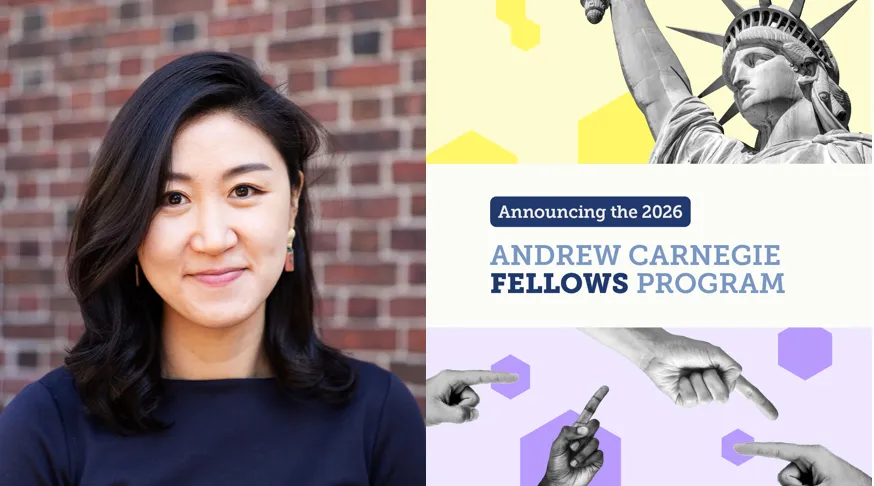
Professor Eunji Kim of the Department of Political Science has been named a 2026 Andrew Carnegie Fellow, Carnegie Corporation of New York announced today. She is among twenty-four scholars who will each receive a $200,000 research stipend to explore the causes of political polarization and to identify possible solutions.
The class of 2026 marks the third cohort focused on developing a body of rigorous, evidence-based research about what can be done to strengthen the forces of cohesion in the United States, an overarching priority for the foundation’s grantmaking. Winning proposals look at topics such as the historical and religious roots of societal divisions in America, how digital communities shape the political identities of young men, and potential institutional reforms in campaign finance, the federal courts, and education, among other areas.
Carnegie has committed a total of $18 million to scholarly research focused on polarization, providing grants to 78 fellows since 2024. The funding allows scholars to take a sabbatical of up to two years and devote themselves to their work, making the Andrew Carnegie Fellows Program one of the most generous stipends of its type.
“We are thrilled that Professor Eunji Kim’s groundbreaking work has been recognized by Carnegie Corporation through this new grant,” said Amy E. Hungerford, Dean and Executive Vice President of the Faculty of Arts and Sciences. “At a time of growing political polarization – particularly in online contexts – Arts and Sciences faculty have so much to contribute to understanding its root causes and offering potential solutions. Professor Kim’s research is timely and essential, and we are grateful to Carnegie Corporation for supporting it.”
“Andrew Carnegie saw it as his mission to encourage, in the broadest and most liberal manner, investigations, research, and discovery, and the application of knowledge to the improvement of mankind,” said Dame Louise Richardson, president of Carnegie Corporation of New York and chair of the Andrew Carnegie Fellows jury. "Through support of our fellows, we are continuing that mission and seeking to harness the insights of scholars of all ages, stages, and disciplines to help us understand the nature of political polarization in the United States today and to devise a means of mitigating its impact on American society.”
Professor Kim’s project, “Online Gaming and Political Polarization Among Young Men,” will investigate how gaming environments, where 70 percent of men under 30 spend their leisure hours – have become one of the most powerful but least understood sites of political socialization, shaping attitudes toward democratic norms, gender, and extremism.
Combining a large-scale survey of young men, analysis of Discord and Twitch conversations, and interventions with streamers and moderators, Professor Kim’s project will move from diagnosis to design by generating both rigorous evidence of gaming’s political effects and practical tools that platforms, parents, and policymakers can use to reduce polarization.
The project builds on Professor Kim’s extensive research on how cultural narratives shape mass beliefs and political behaviors. Her work challenges the boundaries of political science by showing that the media we consume for pleasure are not peripheral to democracy, but central to it. Her first book, The American Mirage: How Reality TV Upholds the Myth of Meritocracy (Princeton University Press 2025; Winner of 2026 Goldsmith Book Award from Harvard Shorenstein Center on Media, Politics and Public Policy), reveals how the rags-to-riches narrative embedded in entertainment media sustains Americans’ faith in upward mobility amid growing inequality.
In addition to her research, Professor Kim co-teaches the university’s celebrated cross-disciplinary course “Persuasion at Scale: Machine Learning, Causality, and the Information Ecosystem,” with New York Times Chief Data Scientist Chris Wiggins.
"The Department of Political Science is very proud that Professor Eunji Kim's work on online gaming and polarization is being supported by this prestigious grant,” said Page Fortna, Harold Brown Professor of US Foreign and Security Policy, and Chair of the Department of Political Science. “Kim is doing incredibly innovative and exciting work on the political implications of entertainment, including reality TV shows, cop shows, and now online gaming. She is uncovering important forces that shape American politics in places no one else has thought to look."
Carnegie Corporation’s 2026 nomination cycle drew a record 381 submissions. The winners consist of 12 scholars from public universities, 11 from private universities, and one from a public university in Canada. Sixteen are tenured, eight are untenured, and they include 13 men and 11 women. The final selections were made by a distinguished panel of 11 jurors comprised of presidents, deans, and senior academics from some of the nation’s premier universities, research institutions, and think tanks.
The criteria prioritized originality and promise, the potential for impact on the field, and the applicant's plans for communicating the research findings to a broad audience. The anticipated result is generally a book or major study. Research by past fellows has led to Congressional testimony that addressed topics such as social media and privacy protections, transnational crime, governmental responses to pandemics, and college affordability. Fellows have received numerous honors through their research, including the Nobel Prize and National Book Award.
Read more about the Andrew Carnegie Fellows Program, the work of past honorees, the criteria for proposals, and a historical timeline of scholarly research supported by Carnegie.
This story was adapted from a press release prepared by Carnegie Corporation of New York.