In Memoriam: Professor Mal Ruderman
The Arts and Sciences community mourns the passing of Professor Emeritus Mal Ruderman

With great sadness, we report the passing of Malvin (Mal) Ruderman, Centennial Professor Emeritus of Physics at Columbia University. Mal Ruderman was a New Yorker and a Columbian through and through. He was born in 1927 within the five boroughs, receiving his AB from Columbia in 1945. Mal completed his PhD at Caltech in 1951 under the supervision of Robert J. Finkelstein, with his thesis titled “Electron Decay of the Pion”. As a young graduate student, he enjoyed frequent discussions with prominent physicists of the time, including Oppenheimer, Feynman, Fermi, and many others. After his PhD he became a professor at UC Berkeley in 1953, before moving back to his hometown in 1964, first as a professor at NYU and then to Columbia in 1969, where he served as chair of the Department of Physics from 1973-1975. In 1957 he was named a Guggenheim Fellow, in 1972 he was elected to the National Academy of Sciences, and in 1996 to the American Philosophical Society. Mal was a founding member of the elite "JASON" group, whose goal is to provide independent scientific and technical expertise to the US intelligence and defense communities.
Mal’s contributions to physics were wide and deep. Some of his earliest work came in the field of condensed matter physics. With Charles Kittel in 1954, Ruderman discovered what is now called the RKKY interaction between nuclear magnetic moments in metals (independently discovered at the same time by Kasuya and Yosida). This interaction is essential to our understanding of magnetic metals and is of fundamental importance to condensed matter physics as the first demonstration of how singularities associated with the Fermi surface could produce qualitatively new effects.
Mal's interests later drifted towards astrophysics, particularly the collapsed objects known as neutron stars, which were discovered as radio pulsars in 1967. In 1968, Mal was the first to realize that the outer layers of neutron stars were crystallized, and formed a solid “crust”. In 1969 he was the first to propose that the sudden speed up in rotation of the Vela pulsar (a so-called "glitch") was due to cracking of the star's solid crust (a so-called “star quake”). Later that year with Baym, Pethick, and Pines, he was the first to interpret pulsar glitches as evidence of nuclear superfluidity in neutron star interiors. In 1975 with Peter Sutherland, Mal published his seminal work on pulsar emission titled “Theory of pulsars: polar gaps, sparks, and coherent microwave radiation”. This paper laid the theoretical framework for all future models of electron-positron pair production and coherent emission above pulsar polar caps. It remains among the most influential and highly cited works on pulsar emission to this day. In 1977 with Elliott Flowers he discovered an instability of magnetized stars, now known as the “Flowers-Ruderman Instability”, which has deep implications for the topology of magnetic fields in stellar interiors. In 1982 with Alpar, Cheng, and Shaham, he proposed that weakly magnetized neutron stars could be spun up to millisecond rotation periods by accretion from a binary companion. It remains the most widely accepted theory for the origin of millisecond pulsars.
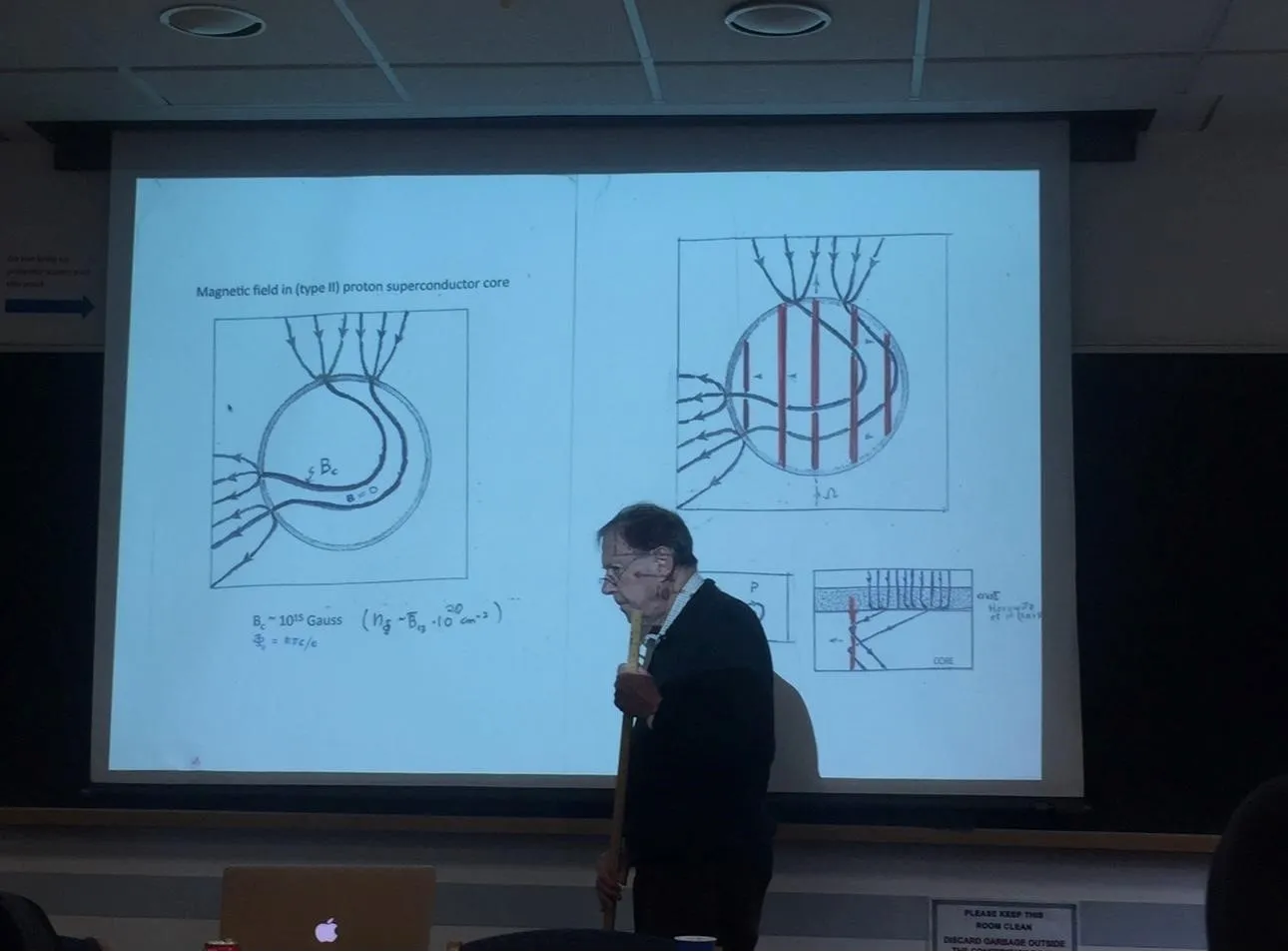
Throughout his career Mal found great pleasure in pondering the vast unexplained landscape of radio pulsar data, and trying to connect the dots. He worked on near impossible problems in neutron star interiors, which he distilled into simple cartoon drawings and back-of-the-envelope estimates. His scientific presentations on these matters were often prefaced with “What I’m about to tell you is either true, or very interesting”. His presentations were famous for his hand-drawn diagrams of superconducting flux tubes and magnetic field lines (Figure below), which are known as “Ruderman style drawings”, among those who work on neutron stars.
In addition to his impressive scientific feats, Mal was known as a kind teacher. For many years he taught a class at Columbia called “Order of magnitude physics”. It was known as one of the fun classes among PhD students. Homework problems required students to estimate the number of piano tuners within 10 blocks of campus, or to calculate the time to cook the Thanksgiving turkey. Many homework sets were returned from grading with the comment “You burnt the turkey!”. Mal taught this class until the Covid pandemic of 2020 – he was 93 years old. He retired in 2022 at the age of 95.
Mal’s students and colleagues remember his warm nature and infectious enthusiasm. He was known to call students on the telephone at unusual hours to share a new idea, and he would frequently drop into a colleague's office and ask “have you got 5 minutes?”. He would then proceed to spend several hours at the colleague’s blackboard explaining his latest idea on the superfluid dynamics inside a neutron star or on the geometry of a neutron star’s magnetic field.
Mal will be remembered as a creative thinker and a kind soul. He inspired generations of young astrophysicists. He was deeply respected by his colleagues, and loved by his family and friends. He is survived by his wife Paula, their three children, Peter, Robert, and Nina, and their grandchildren.