Curricular Innovation: AI in Society
A new course developed by Professor Gil Eyal explores the impact of AI across a broad range of educational, social, cultural and professional settings, and challenges students to be more aware in their use of AI tools.
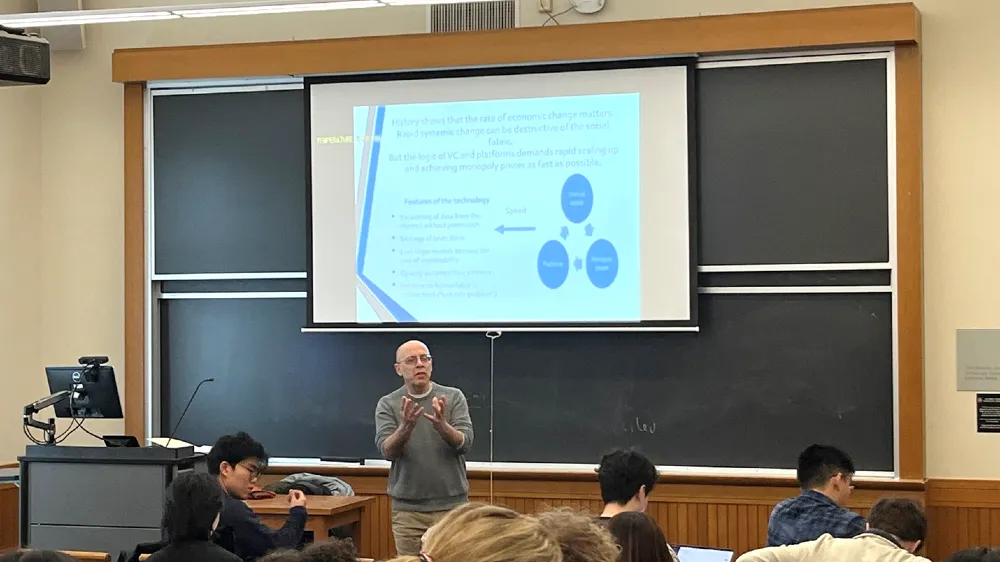
In Spring 2026, Professor Gil Eyal stepped into his Hamilton Hall classroom to teach, for the very first time, a new course on the rapid rise of AI and its impact. His aim was to foster a different kind of conversation – and understanding – of AI, not from the perspective of a computer scientist or engineer, but a sociologist who has spent his career thinking about how science and technology shape our society.
“Our society is currently being transformed by the addition of a new member – Artificial Intelligence,” notes Professor Eyal. “We are already interacting with AI in various settings – schools, workplaces, hospitals, apps on our phone – and this is likely to increase in the future. We would like all Columbia students to be equipped with a few insights that derive from science and technology studies about this transformation.”
The new course – AI in Society – is the first of its kind offered by the Department of Sociology. Unlike others at Columbia, it takes a social science approach to understanding AI and its impact. It also seeks to train students in how to critically engage with AI, including hands-on use of AI tools, to both cut through the hype, and to ensure that AI is being used to augment human ambition and achievement, not the other way around.
Eyal, a Professor of Sociology and former department chair, studies the intersection of science, technology, and society, with a particular focus on the sociology of expertise – a broad field that encompasses sociological research on science, medicine, professions, intellectuals and knowledge, especially as they intersect with political and legal institutions.
At Columbia, he also directs the Trust Collaboratory, a multidisciplinary research center that studies how trust is fostered and maintained in democratic society – something that cuts to the heart of discussions around AI. As part of this work, he has helped spearhead the Listening Tables, an effort to foster new forms of dialogue and understanding across campus. More recently, he helped launch teLLMe – the Citizen AI Project, which seeks to develop a responsible and trusted process for the development of AI-powered applications at the community-level.
Professor Eyal developed “AI in Society” in collaboration with three PhD students: Ari Galper, Emily Mazo and Anna Thieser. A fourth, Claire Corsten, joined the team later. “The final shape of the course is in equal measure everyone’s contribution,” he notes. “The TAs especially crafted the hands-on assignments that make this course an interactive pedagogic setting. Some of the TAs are writing dissertations on the social dimensions of AI and were drawing on their research. Others brought their keen sociological sensibilities as well as their experience as teachers.”
Professor Eyal and his TAs recently shared a few insights about the origins of new course, some potential lessons for the Columbia community, and where they hope the conversation will go in the future.
How did the idea for the course come about?
We began organizing a regular workshop on the sociology of algorithms (originally with funding from the Institute for Social and Economic Research and Policy) in 2021. That workshop was built on several years of cutting-edge research on the increased integration of machine learning and deep learning algorithms into social settings. Sociologists are interested in everything that plays a role in shaping social interaction, structuring inequality, or the distribution of power in organizations, or the recognition of claims to expertise (to name a few). It was becoming increasingly clear that the spread of sophisticated algorithms coincided with changes in these social realms.
We reasoned that just as core curriculum courses are meant to prepare students to reflect deeply on human values and become informed and active citizens, there was a need for a course that prepares students to become informed and active citizens in a world where interaction with AI will become a routine dimension of work lives, political participation, cultural consumption and social relations.
Was there a particular impetus to mount the course now?
The launch of ChatGPT in 2022 added significant urgency to our research and introduced several new dimensions to which this course is trying to respond:
First, much more than previous algorithms, the social setting impacted by Large Language Models (LLMs) is our own, namely higher education. For better or worse, LLMs are having an impact on how students’ work is evaluated, and as a result also on the learning process itself.
Second, the launch and rapid spread of LLMs is also reshaping what our students are doing immediately after college, namely their job search. They hear about whole lines of work going extinct, even as they contend with hiring processes that increasingly rely on some form of Machine Learning/AI to read and evaluate applications, predict who is likely to be a good worker, etc.
Third, the launch and rapid spread of LLMs was accompanied by a hype tsunami: a bestseller philosopher comparing the significance of AI to the development of language itself; a “Godfather of AI” telling radiologists to look for another job; AI safety advocates authoring a book titled “If Anyone Builds it, Everyone Dies”; and inconceivable amounts of money being spent and invested along with the hype.
Finally, LLMs differ from many other forms of AI in being interactive and thereby exploiting the well-documented (by sociologists, anthropologists and linguists) human skill for “repairing” interaction and performing “facework” for others, without even noticing it.
To leave our students to contend by themselves with these profound changes, surrounded by hype and without systematic understanding of human-computer interaction, would have been pedagogic malpractice.
Are there elements of the course you consider particularly innovative or that depart from how you usually teach or assess student learning?
This course is rich with hands-on assignments that cannot be simply outsourced to an LLM. Some can only be done in real life by a human; others require the use of LLM but are structured so as to teach reflexive and informed use of LLMs.
These are very inventive assignments that the TAs worked hard to craft. They include an AI audit (we’ll say more about it later). We also ask students to interview a worker whose employment has been impacted by the introduction of AI (from losing one’s job, to being told to only code with AI, to being surveilled and assessed by AI). Another assignment asks students to interact with an AI companion, bring the chat log to the discussion section, and work in groups on analyzing the interaction.
Many of the assignments require the use of LLMs, but it comes with a “tax,” so to speak. For example, a written reflection – what worked and what did not work well? What have you learned in the process of using this particular AI tool? Calling it a “tax” could imply that it is meant to dissuade students from using AI, but this is not the point.
The message we are trying to convey to students is not “don’t use AI,” but something like “if and when you are using or interacting with AI, something that will become more and more inescapable in the future, be reflective and aware of what you are doing, what are the implications, and what it does to you.”
Is there any early learning you can share from the assignments?
We have already learned that students - even bright Columbia students - are in awe of AI and are convinced that it will do a better job than them. The assignments - of which we are very proud - are calculated to inoculate them against this disabling effect of AI:
First, there are plenty of things students do much better than AI.
Second, relying on AI subtly (and sometimes not so subtly) subverts what the job was meant to be. AI does well machine sort of things, not so well human things.
Third, this should not be a competition, human vs. AI. It should be about learning how to team up with the AI in a way that is not disabling, but enabling; a way that does not make humans more like the machine, but uses the machine to lift the human bar higher.
What would you like students in the class – and the broader Columbia community – to understand about AI from a social science perspective?
First, as with past technological transformations, the final shape of the technology and its impact on society is contingent on design choices being made now that are shaped by a variety of social, economic and political interests. The AI we are being given does not have to be this way. Other routes are possible and they should be a matter of public discussion and collective choice because they will shape future society in the same way that constitutions do.
Second, and relatedly, AI is never just AI. There are always humans-in-the-loop, whether as investors, designers, ghost labor, supervisors, trainers, fine-tuners, collaborators, and last-but-not-least, us, the users. To be active and informed citizens in a society in which interaction with AI is ubiquitous, it is not enough to know how neural networks work. It is also necessary to understand how this socio-technical network of both humans and devices is put together, and what nodes could be replaced to build a more responsive and fairer network.
Third, we would like students to be able to buffer the rhetoric of “intelligence,” and replace it with attention to interaction. Intelligence is a term with a checkered history, more often than not serving as a way of allocating differential worth to beings. The word, "intelligence," is a poor guide for how to think about the ways in which algorithms and computer technology should be integrated in social settings. Instead, we want students to pay attention to how meaning and use are co-constructed in interaction.
Expertise, the ability to perform certain tasks better, faster and with greater certainty of success, is located neither in the human expert nor in the decision-support algorithm, but in their combination. Instead of being in awe of artificial intelligence, we want students to attend to patterns of human-computer interaction with the goal that these augment humans, not diminish them.
How does the course engage questions about trust in the context of AI? Has AI fundamentally breached certain kinds of trust that will be difficult to regain?
We deal with the question of trust towards the end of the semester, in a week dedicated to “the last mile problem in AI.” The term “last mile” comes from logistics, but in high-tech it often stands for all that is human, all-too-human.
AI engineers often speak about “trustworthy AI.” They mean building the sort of AI that people should trust because it is transparent and trained on curated and validated databases. Their efforts definitely should be applauded. But the “last mile” problem is how to get from something that people should trust to something that they actually do trust?
This is a complicated question that requires understanding how people trust, but one thing is for certain: “move fast and break things,” which is how LLMs are being rolled out, is not a recipe for trust. Once you move fast and break things, the promise to build trustworthy AI rings hollow.
There is another dimension to the question of trust, and it serves more as an overall context for the course, and an important learning goal. We are currently at the low ebb of public trust in government institutions, in the media, in science, experts and medicine, even in one another. When trust in people and their institutions fails, the temptation is to turn to the objectivity of machines and algorithms and data as a replacement. It is a false promise, because machines and algorithms and databases are composed of multiple subjective design choices. Once the subjectivity and biases of the AI come to light, as they always do, we will remain with neither trust in objective machines, nor trust in subjective humans and their institutions.
For this reason, the final assignment in the course is designed to inoculate students against the rhetoric of objectivity. They will learn how to “audit” an LLM, in the same way that social scientists conduct audit studies of hiring processes, to reveal the subjectivity and bias built into the LLM’s training data or design choices.
What is one thing no one is talking about – but should be – related to AI? And where do you see the conversation heading in the next year or two?
In the first week of the course, we conducted a small survey of students’ experiences and opinions regarding AI, especially in educational settings. What we discovered shouldn’t be surprising, but is important to spell out.
Students report that they, at one and the same time, use LLMs fairly often in their academic work, feel vaguely guilty about this, and experience this as an ambiguous “grey zone” where they were left to their own devices to decide what is right, while the persistent hype makes them feel that if they do anything else, they will lose out in the competition (because they perceive their classmates as using LLMs much more than they do.). There is so much guilt, moral panic, and morally charged language surrounding the academic use of LLMs. A grown-up conversation is overdue about the impact on students and between students.
It seems to us that one answer at least lies in emphasizing the things that Columbia specifically, and most universities by extension, always demanded as a crucial element of its pedagogy: intensive reading and writing. It is not often recognized that good old- fashioned reading of long, difficult books and composing critical essays are actually good for helping students to understand AI, its relative strengths and weaknesses, its potential benefits and risks, and more.
The ability to concentrate on – and engage critically with – a text or a problem may even help to inoculate students to the risks of AI and help them take advantage of its benefits. It can also help students to regain appreciation for their own skills and help them think through and anchor an intellectual identity that can outlast the various transformations that we are likely to endure in coming decades.
There is a reason why Columbia calls its curriculum “core.” It can help build in students a versatile intellectual and ethical core that can remain steady even as the ship is tossed about.