Columbia to Lead $20 Million National Research Center on Organismal Resilience
Funded by the National Science Foundation, the National Synthesis Center for Organismal Resilience will leverage real-world data and innovative AI techniques to improve understanding of how plants and animals build resilience in dynamic environments.
The National Science Foundation has selected Columbia University to establish a National Synthesis Center for Organismal Resilience (NSCORE), a multidisciplinary research center that will catalyze an international community of biologists and computer scientists to better understand, predict, and identify actions to improve organismal resilience.
Located in the heart of Columbia’s Morningside campus, NSCORE will operate as a global hub – both physically and virtually – bringing together researchers, students, educators, as well as national and international partners to study animal and plant resilience over the next five years. NSCORE will employ cutting-edge approaches in artificial intelligence and data science, leveraging expertise from Columbia’s Faculty of Arts and Sciences, School of Engineering and Applied Science, Data Science Institute, and other university and external partners. By combining organismal biology with computer science into the emerging field of computational organismal biology, NSCORE will enable unprecedented insight into one of the most critical and growing challenges of our time.
“Columbia has a long and proud history of advancing scientific discovery by bringing together extraordinary people, ideas, and disciplines,” said Jennifer Mnookin, President of Columbia University. “NSCORE builds on that tradition in an exciting new way, combining advances in biology, artificial intelligence, and data science to deepen our understanding of how living systems adapt and thrive in a rapidly changing world. We are grateful to the National Science Foundation for this investment in Columbia and I am especially excited that NSCORE will bring researchers and students from around the world together to ask these ambitious questions and develop new approaches to understanding the world around us.”
“We are thrilled Columbia will be home to NSCORE and benefit from our scholarly expertise in the natural sciences, engineering, data science, and other fields in support of understanding resilience,” said Angela Olinto, Provost of the University and Rutherfurd Professor of Astronomy and Physics. “The Arts and Sciences, School of Engineering and Applied Science, Data Science Institute and many others will be vital contributors to this effort. We are grateful for their collaboration and for the tremendous insights we know they will bring.”
Addressing a Central Scientific Challenge: How Organisms Build Resilience
Many organisms have the capacity to develop a wide range of responses to dynamic natural environments. Understanding how they build resilience in these changing conditions involves careful study of their physical, chemical, molecular, neurological, and biological systems over their lifetimes and across longer evolutionary timescales during which genetic variation can accumulate. NSCORE will take an integrated approach to studying these factors – analyzing both the drivers of change and identifying more effective ways to predict how organisms will build future resilience.
Rather than generating new data, NSCORE – like other NSF synthesis centers – will be designed to facilitate integration and synthesis of available data by interdisciplinary research teams. Researchers will seek to address compelling scientific questions with the data. Key to NSCORE’s approach will be the synthesis of large data sets of individual organismal traits coupled with environmental data from remote sensing, global networks, and real time monitoring techniques. Combining modern data storage and management with cutting-edge AI methods, NSCORE will make it easier for scientists to discover, build, share, and analyze cross-disciplinary data, including information previously inaccessible due to geographic, technical, or other barriers.
NSCORE is a coordinated effort across Columbia University and an ecosystem of partners.
Amy E. Hungerford, Dean and Executive Vice President of the Faculty of Arts and Sciences, said, “We are excited to bring to bear the immense talents of our Arts and Sciences faculty in collaboration with our Columbia colleagues and distinguished partners to transform understanding of organismal resilience at a time when it has never been more urgent.”
Shih-Fu Chang, Dean of Columbia Engineering, added, “The Fu Foundation School of Engineering and Applied Science is proud to be a partner in NSCORE, enabling the analysis of biological and earth data and development of leading-edge AI and data management tools which will be central to NSCORE’s success.”
Garud Iyengar, Avenessians Director of Columbia’s Data Science Institute said, “The Data Science Institute fosters impactful interdisciplinary collaborations, breaking down silos, and designing innovative programs that leverage data science and AI. We are excited to support this element of NSCORE’s mission and the broader awareness it will foster.”
Working Groups, Conferences, Training, and Partnerships
Beyond analysis and synthesis of data, NSCORE will serve as a hub for convening, training, and community building. It will host working groups of experts and learners from local and international communities to engage central questions related to organismal resilience, convene annual conferences designed to spark new collaborations and develop concrete implementation plans. NSCORE will also create a hybrid interdisciplinary education and training program that combines broad online reach with deep in-person engagement.
At its center will be the NSCORE Learning Gateway, an online platform intended to scale access to tools, training, and community – complemented by in-person events, including programs designed to broaden participation with local communities and institutions including rural and underserved communities across America.
A National Center
NSCORE will build its research network through active partnerships with private and public academic and research institutions across New York City and the United States, as well as with collaborators across North America, Europe, and Asia. It will directly link Columbia researchers to six NYC-based institutions to engage a broad set of scientists, and to interact with and train large numbers of students and community members from diverse backgrounds across NYC and beyond. Partner institutions in New York City include New York University, Queens College, City College of New York, New York Botanical Garden, CUNY Advanced Science Research Center, and the American Museum of Natural History. An initial set of global partners will include the Max Planck Institute of Animal Behavior (MPIAB) in Konstanz, Germany (with affiliated personnel in Germany and the United States), and Academia Sinica’s Biodiversity Research Center (ASBRC) in Taipei, Taiwan. NSCORE expects to include other national and international partners over time.
“We have assembled a truly amazing set of partners to support NSCORE’s launch and extensive activities over the next five years,” said Dustin Rubenstein, the Thomas Hunt Morgan Professor of Conservation Biology in the Department of Ecology, Evolution, and Environmental Biology in Arts and Sciences, and the Executive Director of NSCORE. “We look forward to working with not only these exceptional scientists and collaborators to realize the vision of the Center and the valuable research it will produce, but also to build and educate a new community and generation of scientists to use the most advanced AI tools to solve big problems.”
NSCORE Leadership
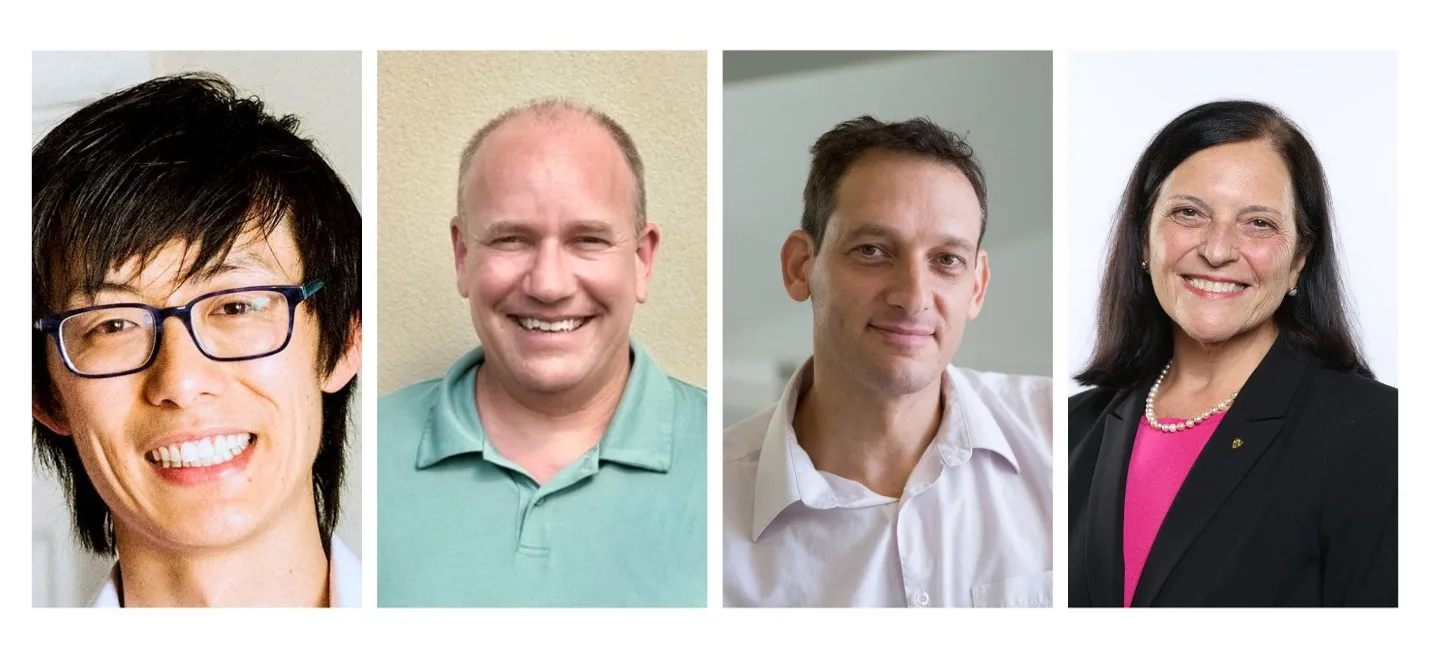
Credit: Steve Zill/Columbia Engineering
The NSCORE leadership team at Columbia includes:
NSCORE Executive Director Dustin Rubenstein, Thomas Hunt Morgan Professor of Conservation Biology in the Faculty of Arts and Sciences, who will serve as the full-time director of NSCORE, overseeing its operations and activities.
NSCORE Associate Director & Integration Officer Itsik Pe’er, Professor of Computer Science and Systems Biology at Columbia Engineering, who will facilitate the integration between the computational aspects of AI and data management and the biological questions posed by the center’s working groups;
NSCORE Director of Data Science Eugene Wu, Associate Professor of Computer Science at Columbia Engineering, who will lead the center’s data science efforts, helping teams identify the computational support they need to assemble and analyze datasets, produce useful open-source tools, shared infrastructure, and data practices, as well as practical lessons about how computer scientists and biologists can work together; and
NSCORE Director of Education, Outreach and Engagement Florence Hudson, Executive Director of the Northeast Big Data Innovation Hub and Interim Executive Director for Sponsored Research in the Data Science Institute at Columbia University. Hudson will collaborate with NSCORE’s ecosystem of leaders, partners, experts and students to design, develop and deploy educational content and programs to bring valuable curriculum and outreach programs for computational organismal biology to learners and educators across the U.S. and around the world.
NSCORE will officially launch on September 14, 2026, with a day-long symposium at Columbia | Zuckerman Institute, featuring leading biologists, computer scientists, and partners involved in the new center. RSVP here if you wish to attend in person or virtually.
For more information, visit the NSCORE website.