Columbia Faculty Help Establish New United Nations University Campus in Hungary
Professor Szabolcs Márka and Dr. Zsuzsa Márka served as key architects of the successful initiative.
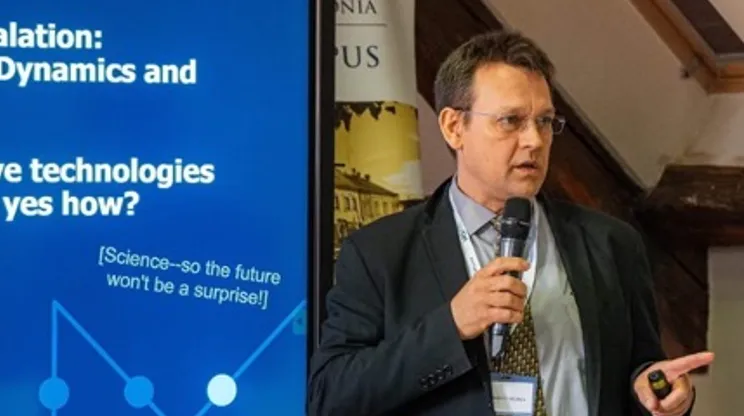
A new institute of the United Nations University (UNU) will be established in Kőszeg, Hungary, marking the first institute located in the former Eastern Bloc and positioning Central Europe as a new hub for policy-relevant research at the intersection of peace, security, science, art, and transformative technologies.
Professor Szabolcs Márka, the Walter O. LeCroy Jr. Professor of Physics, and Dr. Zsuzsa Márka, Associate Research Scientist, Columbia Astrophysics Laboratory, were key architects of Kőszeg’s successful initiative. Both contributed significantly to its vision, focus, and programming over a period of many years, and helped shape the institute's overall purpose and goals. Co-discoverers of cosmic gravitational waves and pioneers of multi-messenger astrophysics, the Márkas scientific research explores the universe by creating a comprehensive, multifaceted scientific framework.
“Bringing a multifaceted vision of boundless natural sciences to the table and working harmoniously with humanists can create unprecedented value for the emerging minds of the future,” noted Dr. Márka in outlining her support for research-based education at the institute. Professor Szabolcs Márka added, “Beyond seeking fundamental discoveries, scientists should also invest in improving human life on Earth by utilizing their expertise and creativity. Science can make us live happier, healthier, and longer lives; moreover, engagement in art and exploration can make life worth living!”
United Nations University was established in 1972 to serve as a global think tank and postgraduate teaching organization, working with leading universities and research institutes in UN Member States and serving as a bridge between the international academic community and the UN system. Headquartered in Tokyo, Japan, UNU currently encompasses 13 institutes in 12 countries.
The new institute is being launched through a host-country agreement between the Government of Hungary and the United Nations University, with the Institute of Advanced Studies Kőszeg (iASK) serving as the host partner. The new UNU institute in Central Europe will advance futures literacy as a core tool for addressing geopolitical conflict in an era increasingly shaped and strained by rapid scientific and technological revolutions.
In creating the institute, UNU Rector Professor Tshilidzi Marwala noted, the United Nations University’s “role extends well beyond academia…[it] exist[s] to drive progress and to help address the complex challenges facing the world today.” UNU Vice-Rector in Europe Professor Shen Xiaomeng also emphasized the unique importance and timing of the establishment of the institute: “As we are facing an increasingly polarized world along with other major global challenges…[and] solutions can only be found through international collaboration, hence the necessity to build strong partnerships, locally, regionally and globally. This new institute sets the example for such cooperation to jointly strengthen multilateralism.”
Professor Ferenc Miszlivetz, director general of iASK, played a central role in this complex, multi-year effort, bringing decades of experience in convening interdisciplinary networks and translating research into public impact. Professor Miszlivetz served as the István Deák Visiting Professor at Columbia University’s Harriman Institute in 2012, reinforcing a deep connection between Columbia University and Central Europe that now informs the new UNU campus’s international orientation.
Reflecting on the institute’s mission, Miszlivetz noted that “this new UNU institute has galvanized cooperation among Hungarian and Central European institutions and is already bringing together partners, universities and municipalities to build viable visions, strategies and recommendations for regional governments. The institute will drive new collaborations at global, regional, and local levels of research and policymaking, and create a wider scope to find holistic approaches to complex global challenges.”
Opening new windows on global thought in Central Europe and the Balkans highlights Columbia University’s global role in shaping intellectual directions worldwide. It also reflects the university’s capacity to advance complex, multi-stakeholder negotiations on humanity’s most pressing challenges, which can be addressed only through seamless collaboration among the broadest minds from the natural sciences and the humanities, as well as policymakers and strategists.
With Kőszeg’s symbolic location near the Western Balkans and its proximity to European capitals, including Vienna, Budapest, Bratislava, Ljubljana, and Zagreb, the institute aims to become a platform where rigorous research, cross-border collaboration, and practical solutions converge to shape a more peaceful and cooperative global future.
This story was adapted, in part, from the original United Nations University announcement.