Accelerating Breakthrough Discoveries in the Basic Sciences
A new philanthropic initiative within the Arts and Sciences is supporting early-stage, high-reward projects across a range of exciting scientific areas.
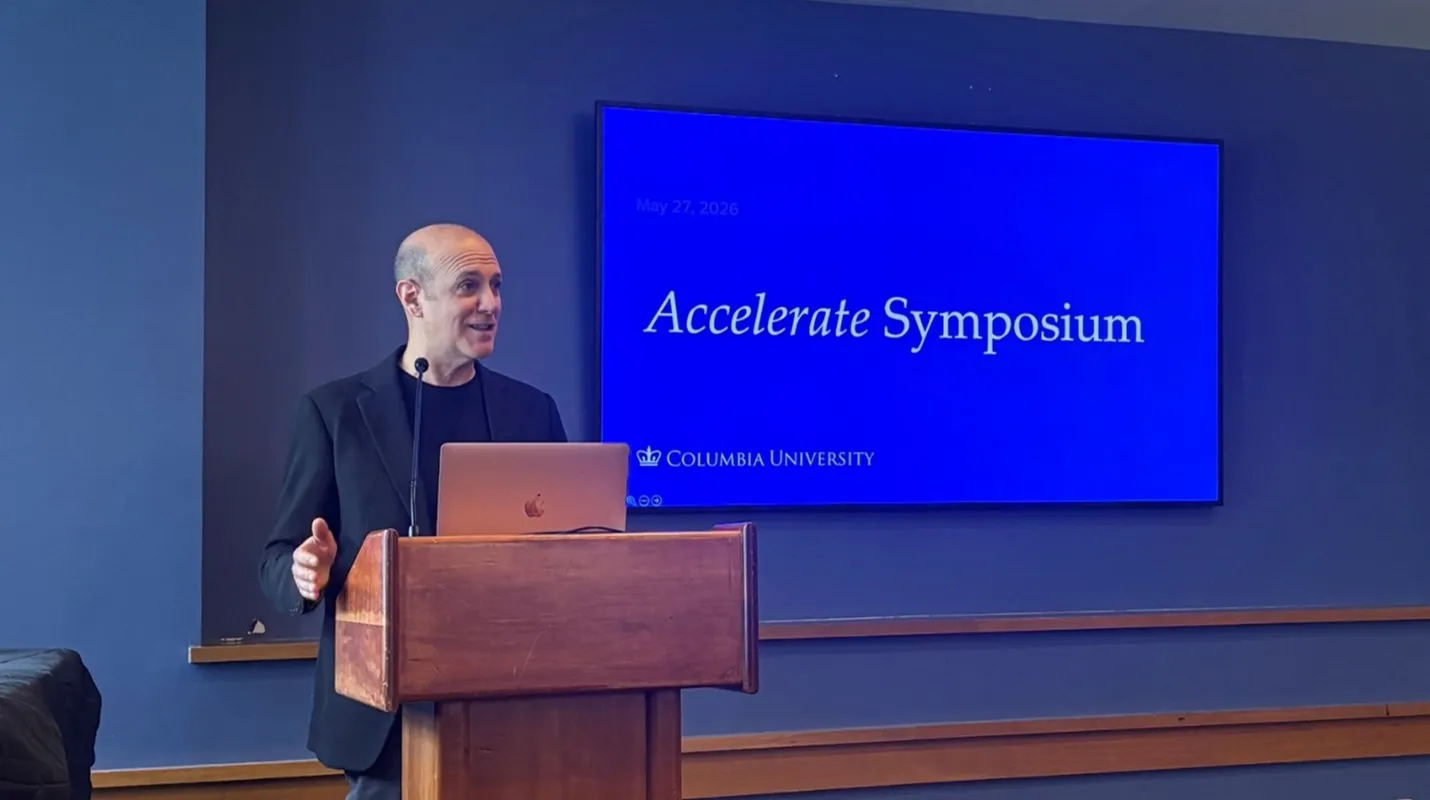
On May 27th, Arts and Sciences faculty, donors, university leaders, and students gathered on campus for the inaugural Accelerate Symposium to mark the first cycle of a new donor-supported seed fund that aims to fuel bold scientific advances in the basic sciences.
A joint effort between the Division of Natural Sciences and the Office of Alumni and Development, Accelerate provides funding for early-stage research ideas that have the potential for high-reward scientific discoveries. As such, the program continues a long and successful tradition at Columbia of using seed funding to invest in breakthrough science – from the development of the MRI to early investments in semiconductor research to new discoveries about the human microbiome and new research to address climate change.
“Accelerate was created around a very simple but powerful idea: that some of the most transformative scientific discoveries begin as ambitious, unconventional, and sometimes speculative ideas that are not yet ready for large-scale federal and industry funding,” noted Ruben Gonzalez, Dean of Science and Professor of Chemistry, in opening remarks at the Accelerate Symposium. “But [they] nevertheless have the potential to fundamentally reshape how we understand the world.”
“The goal of Accelerate is to help bridge that gap,” continued Dean Gonzalez. “[It will] provide catalytic support at exactly the stage when scientists need the freedom to explore bold new questions, develop new technologies, generate proof-of-principle data, and pursue ideas that may initially seem too risky, too interdisciplinary, or simply too early for traditional funding mechanisms.”
Established in 2025 through the generosity of donors, Accelerate issued an open call for proposals from Arts and Sciences faculty across the Division of Natural Sciences, ultimately funding four projects that span multiple research areas and departments.
The four inaugural awardees – Professor Galen McKinley of the Department of Earth and Environmental Sciences; Professor James McIver of the Department of Physics; Professor Lorenzo Sironi of the Department of Astronomy; and Professor Dustin Rubenstein of the Department of Ecology, Evolution, and Environmental Biology – were on hand at the symposium to present their seed projects and offer additional insights into their research goals.
Professor Galen McKinley’s Accelerate project asks a deceptively simple but scientifically important question: do bubbles matter in how the ocean exchanges gases like carbon dioxide and oxygen with the atmosphere? Answering that question has important implications for modeling climate systems, understanding ocean-atmosphere interactions, and predicting the future behavior of Earth’s climate.
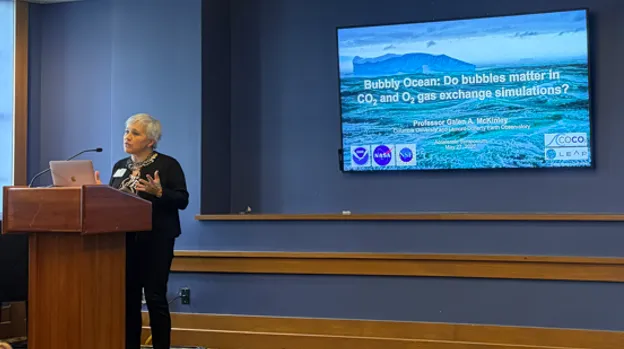
For the project, Professor McKinley’s team has developed a state-of-the-art regional ocean simulation model that will assimilate data on biogeochemical processes and bubble-mediated gas exchange. Once analyzed, the data could yield new insights into the importance of gas exchange for quantifying air and sea carbon dioxide and oxygen fluxes, the global carbon budget, and ultimately, efforts to reduce the amount of carbon dioxide in the atmosphere.
Professor James McIver of the Department of Physics is exploring new ways of controlling light and electromagnetic fields that may help create high-temperature superconductivity in advanced quantum materials – allowing electricity to flow with essentially no energy loss. For his project, Professor McIver and his team are using an ultra-thin form of carbon called twisted trilayer graphene that is known to host superconductivity under special conditions.
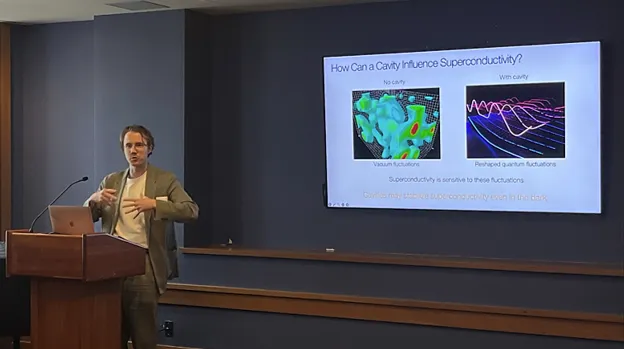
By placing the material inside microscopic cavities that confine light, he and his team will try to determine whether light can be used not just to measure superconductivity, but to actively influence it. The results could have long-term implications for energy-efficient technologies and future quantum devices.
Professor Lorenzo Sironi of the Department of Astronomy is using Accelerate funds to seek new insights into cosmic rays, the highest energy particles in the universe. Through advanced simulation and machine learning, he will investigate the origin of cosmic rays, including by leveraging a large library of kinetic shock simulations paired with intensive hybrid modeling.
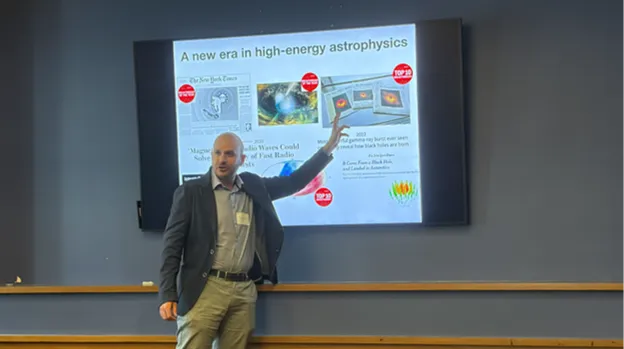
This work sits at the intersection of astrophysics, computation, and fundamental physics, and will address questions that are both technically challenging and profoundly fundamental.
Professor Dustin Rubenstein’s project investigates how organisms may biologically adapt to changing and unpredictable environments across generations. Drawing on 25 years’ worth of DNA samples from his long-term study of a common African bird, the Superb Starling, his team will seek to determine if environmental conditions that offspring experience in early life – or even the conditions parents experience prior to their birth – may program the genome to cope with future environments via epigenetic mechanisms.
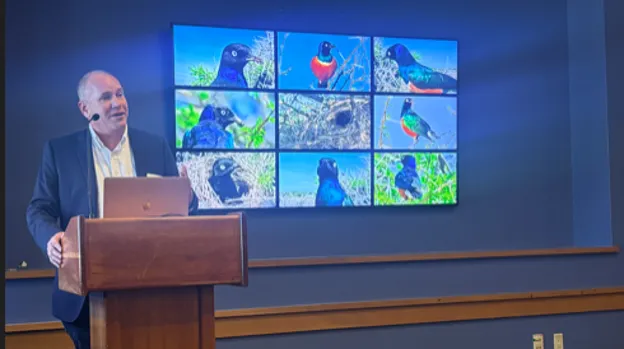
His project holds the potential to broaden understanding of the molecular mechanism by which organisms program the development of their offspring to cope with fluctuating environmental conditions – and how this programming influences their subsequent behavior, survival, reproduction, and resilience to a changing world.
“[These] are exactly the kinds of ambitious early-stage projects that can eventually grow into major scientific advances, new technologies, and entirely new research directions,” shared Professor Gonzalez in closing remarks. “And importantly, these projects are only a small glimpse of the remarkable scientific ideas emerging across our faculty and trainee community.”
Building on its early success, additional awards under the Accelerate program are expected to be made in the fall thanks to the ongoing generosity of donors to the program. Indeed, in many ways Accelerate is built around the philosophy that philanthropy can play a unique role in science.
“It can move earlier. It can move faster. And it can empower creativity in ways that are sometimes difficult for more traditional mechanisms,” noted Professor Gonzalez. “And that flexibility is especially important in the sciences today.”